Past Programs
PROGRAM SPOTLIGHT
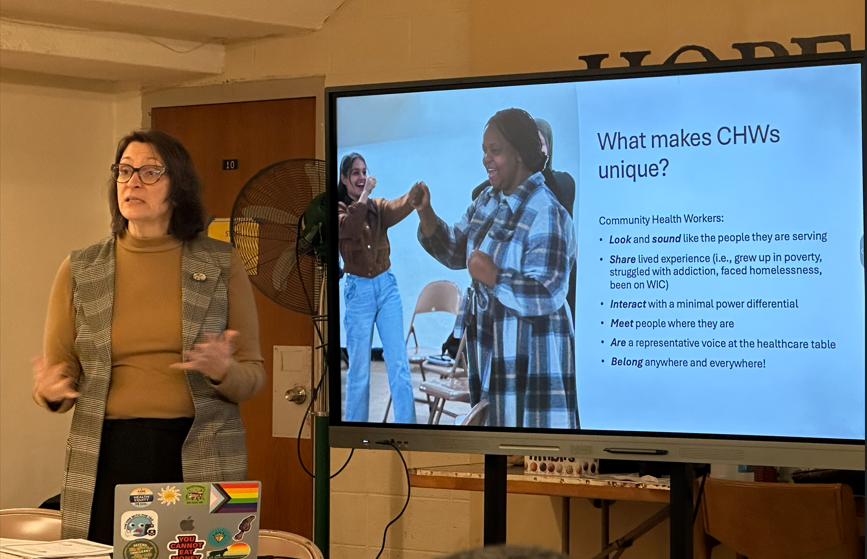
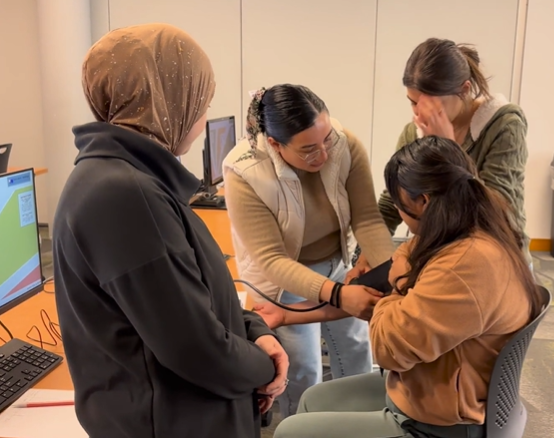
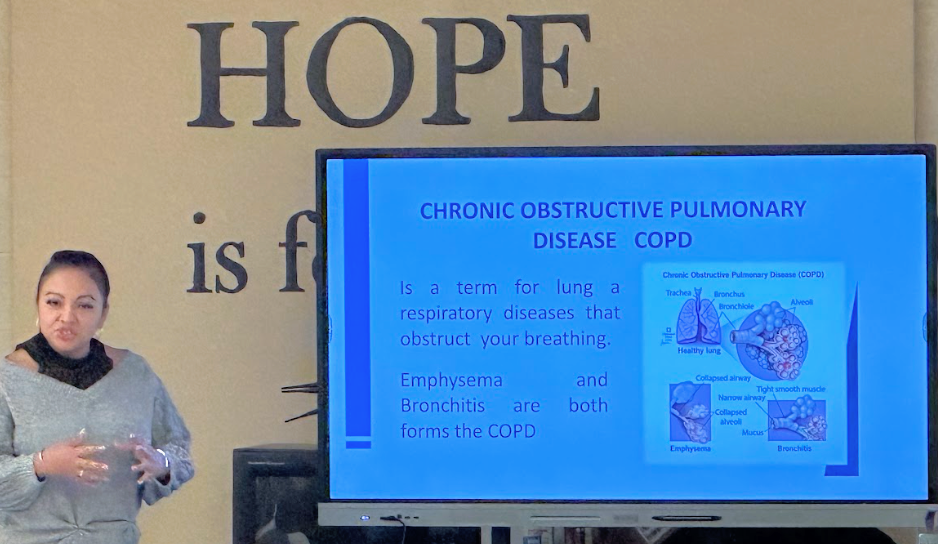
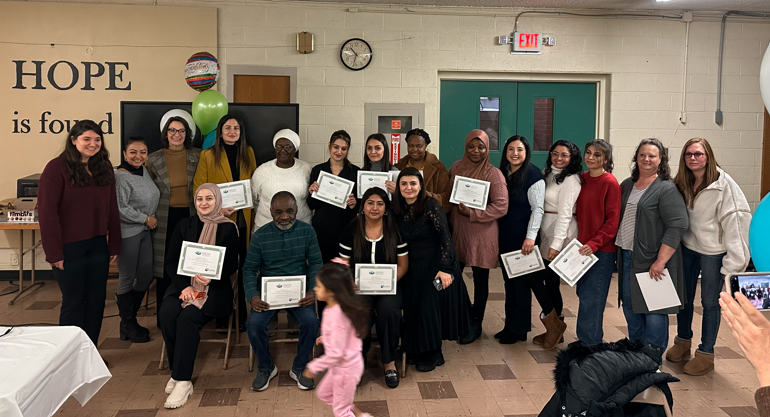
In 2025 we received a grant from the Ohio Center for Community Health Workers Excellence through Health Impact Ohio which allowed us to offer a six-month intensive ESL program for internationally trained healthcare professionals—including doctors, nurses, pharmacists, and others pursuing healthcare careers.
Graduates of this program successfully enrolled in the Ohio University Community Health Worker certification, which was offered on-site at our Dayton office.
This grant-funded opportunity drew upon the established success of the Ohio Center for Community Health Workers Excellence, whose mission is to grow, strengthen, and support Ohio’s Community Health Workers to create a prepared, equitable, and sustainable workforce. The Ohio Department of Health defines Community Health Workers as “trained public health workers who serve as a bridge between communities, health care systems, and state health departments.”
The program instruction was led by Keri A. Shaw, MSW, LISW-S, C.CHW, an Associate Professor of Instruction at Ohio University and the Community Health Worker Program Lead for the OHIO Alliance for Population Health. She has twenty years of practice experience in southeast Ohio as a school social worker, counselor, program developer, and educator. Since 2015, she has been instrumental in the formation of the Community Health Worker (CHW) program at Ohio University, with an emphasis on workforce development and cultural humility, and has trained over 200 CHWs in southeast Ohio. As a returned Peace Corps Volunteer who spent three years in Paraguay, Shaw is committed to immigration justice and is one of the founding members of the Athens United Immigrant Support Project; she and her family have sponsored multiple asylum-seekers over recent years.
See our YouTube playlist for highlights from the course.
past programs
GED Preparation
In many cases, immigrants and refugees are not able to provide evidence that they earned their educational certificates because they were not able to carry their documentation when they left their homes. Some refugees and immigrants arrive in the US with limited educational backgrounds which limits their job opportunities. The best way to obtain better jobs, enter college or access apprenticeship programs is to obtain a GED (general equivalence diploma). This program helped students prepare for the GED through classes offered for 10 hours a week from Monday through Friday.
Educational Mentoring
Students who enroll in this program will be asked to take a placement test. Based on the result of the placement test score, each student will be placed in one of our seven class levels that best fits their skills and needs, with the exception of Pre-Beginner and Beginner levels.
The Pre-beginner level is for students with little to no literacy skills. Our method of teaching at this level will focus on developing oral competencies before transitioning to reading and writing. This will help students gain conversational English skillsOur Educational Mentoring Program was open to both youth and adults. For youth, this program was best paired with the After School Program since allowed for more one on one interaction between youth and mentors. This style of interaction resulted in a more personalized style of education based off of the youth’s need. For adults, this program was best for individuals who wanted a smaller class size and more personalized assistance. Mentor and students scheduled a time to meet once a week, virtually or physically to share some activities and updates. The mentor served as an advisor to the students and helped address any issues or concerns.
ESL Classes
Students who enrolled in this program were asked to take a placement test. Based on the result of the placement test score, each student was placed in one of our seven class levels that best fit their skills and needs, with the exception of Pre-Beginner and Beginner levels.
The Pre-beginner level was for students with little to no literacy skills. Our method of teaching at this level focused on developing oral competencies before transitioning to reading and writing. This helped students gain conversational English skills that allowed them to interact with their teachers but at the same time be able to get-by in the community by themselves. The Beginner level was for students with literacy skills in other languages but with little or no English skills. The rest of the groups were placed according to the scores they achieved in the placement tests. Those were Elementary, Pre-Intermediate, Intermediate, Upper-Intermediate and Advanced levels.
Our ESL program also functioned as a site for the TESOL students of Wright State University and University of Dayton to complete their practicum and for community engagement.
ESOL in the Workplace
COCD partnered with community organizations to develop vocational opportunities that tailored to the needs of oral language culture immigrants and refugees, who preferred to learn language alongside practical skills. This program helped participants learn important English vocabulary and phrases that were relevant in the workplace. Each participant had the opportunity to work as an apprentice in in-demand fields, alongside students from our partnered Universities.
SAT/TOEFL Support
Cross Over Community Development offered preparation classes for students who wanted to take the SAT and/or TOEFL test. We wanted our students to succeed and be able to access college scholarships. This program was intended to help students improve their skills and scores in Math and English. Students were evaluated progressively using SAT practice tests. Classes were held every day for two hours at the time agreed upon between students and the tutors.
Summer Youth Program
This program assisted youth in developing fundamental life skills and encouraged personal growth. This program taught youth how to grow their interpersonal relationships, and career development. READ MORE
Family and Consumer Science for ESOL
This program was intended to improve the health outcomes of immigrant families. In this program, students learned how to manage a home. Many immigrants who arrived there had never used household appliances before. With the support of UD scholars, COCD developed videos that introduced students to the use of household appliances, such as dishwashers, refrigerators, washers, dryers, and ovens. This program taught students about topics such as nutrition, menu planning, food preparation, clothing care and construction, money management, grooming, consumer awareness, and child development.
Family Literacy
Understanding that education was a continuous and vital process throughout their lives, COCD developed culturally appropriate instructional videos and audio-visual aids to encourage intergenerational family learning. Family learning aimed to enhance intergenerational bonds and parenting skills through activities such as reading, cooking, and educational games. Parents improved skills such as English, employability, better nutrition, and health to benefit their entire family. This program encouraged awareness of using resources in the local library.
It was widely recognized that acquiring proficiency in a new language was noticeably more pronounced in children than in adults, a trend particularly prominent within immigrant and refugee families resettling in the United States. Such disparity necessitated children to act as interpreters or cultural intermediaries for their parents, disrupting traditional parent-child dynamics and potentially destabilizing the family structure. Additionally, employment proved to be a significant hurdle, as foreign qualifications often went unrecognized, leading many families to resort to low-wage employment in challenging conditions, thus compromising time for family care and personal well-being.
Recognizing these multifaceted challenges, Cross Over Community Development (COCD), with the support of partners, was in the development phase of a comprehensive family mentoring program aiming to bridge English as a Second Language (ESL) learners with supportive networks. This initiative involved recruiting mentors who served as English conversational partners, cultural educators, career mentors, and role models for the youth, as well as providing crucial assistance in navigating the complex web of social networks in the Greater Dayton area.
Family Navigation
With the support of Attorney Katie Wright, Cross Over Community Development (COCD) opened its Family Navigation Program to assist immigrants and refugees in the Greater Dayton Area. Running from December 15th, 2020, the program operated every Tuesday from 3:30PM to 6:30PM at 345 Wyoming ST, Dayton, OH 45410, offering free walk-in services with no appointment needed.
The program was coordinated by Attorney Katie Wright, Assistant Professor of Criminal Justice at Wilmington College and former Adjunct Professor at The University of Dayton. With interpreter support, Katie provided referrals to community services and resources, including education, healthcare, legal services, and advocacy to help families adjust to American culture.
UD and COCD jointly mentored 100 refugee families, building a foundation that helped immigrants and refugees thrive and fully participate in the socio-economic life of their new home country. The partnership achieved significant success through several collaborative projects:
Dr. Molly (Maureen) Keane-Sexton’s students produced infographics on services available to refugees in the Miami Valley and tutored students in math and English. Leslie King, Director of Rivers Institute, led her 2020 cohort in releasing an online children’s book, ‘Into the River,’ which inspired children’s literacy and educated local youth about the importance of rivers in the Greater Dayton Area. The initiative included Zoom reading events and the Karibu Project, which produced educational videos on safe usage of home appliances and urban gardening education.
COCD worked with the UD Department of Teacher Education and UD Employment Services to recruit qualified teachers and staff for the ESL program. When the pandemic forced the ESL program online, COCD successfully recruited new students to replace those who struggled with technology access, with plans to teach basic computer skills once restrictions lifted.
From April through early November, younger students attended ESL classes for four hours daily—an impressive commitment that paid off. With assistance from professional teachers and college professors, students improved their language and math skills dramatically. Five students scored above average on SAT practice tests and successfully submitted college applications, inspiring COCD to expand offerings to include college readiness and computer classes for adult students.
Recognizing that many immigrants and refugees struggled to obtain U.S. citizenship due to limited English skills and civic education, COCD partnered with UD Professor Erika Curran to launch a culturally responsive program that helped numerous individuals pass the U.S. naturalization test. Through these combined efforts, the Family Navigation Program successfully equipped hundreds of immigrant and refugee families with the tools, knowledge, and support needed to build new lives in America.
Naturalization Classes
The COCD Family Navigation Program offered Naturalization classes. Ericka Curran, who was an Immigration Attorney and a Professor of Legal Writing at the University of Dayton, was in charge of this program. Ericka handled the cases regarding adjustment of status and other immigration issues. This program was for individuals who had obtained a Green Card. Individuals who had green cards and were interested in taking and passing the US naturalization test were highly encouraged to take this program. Naturalization classes were scheduled based on the availability of the students and teachers.
The COCD Center for Urban Farming (CUF) in Dayton, Ohio launched a pioneering initiative for empowering refugees and immigrants through sustainable urban agriculture. With an established infrastructure and in collaboration with Ohio State University and Central State University, this program innovated business and marketing models suitable for diverse immigrant communities.
The CUF functioned as a hub of community engagement, fostering intergenerational learning through student interns and senior volunteers. Transforming vacant lots into urban farms, COCD partnered with local institutions to boost community health through food education and farmer training.
With a culturally responsive teaching approach, this program integrated language and skills training to assist refugees in building quality lives, while simultaneously benefiting the local economy. This transformative initiative successfully empowered immigrant and refugee families to develop sustainable agricultural skills and strengthen their economic independence in the Greater Dayton community.
Immigrant participants in our programs received assistance with rental houses or low-income housing applications. We were dedicated to supporting our clients in navigating the complexities of the housing market and ensuring fair treatment. When they encountered adversity due to discriminatory practices by their landlords, we acted as a conduit, linking them with appropriate services dedicated to safeguarding their rights and mediating any emergent issues.
In certain circumstances, bolstered by our network of partners, we extended rental assistance to alleviate immediate housing stress. As we evolved our service portfolio, our direction included expanding our programs. The additions under consideration included Housing Education and Counseling, Transitional Housing, and Home-Ownership Programs. We believed that this expansion would equip our clients with a broader set of tools to navigate the housing landscape more effectively.